Showing posts with label Pleasant Cumiford. Show all posts

Wednesday, February 12, 2014

The Cherokee Nation Protest - Standing Witnesses-Part 8

The Cherokee Nation lawyers launched a strong protest against the Pleasant Cumiford family being enrolled by the Dawes Commission. Below is a timeline of the events that started with Cumiford's Dawes application on November 9, 1900, and concluded March 26, 1904 when the Department of the Interior made its final decision.
  • November 9, 1900 - Pleasant Cumiford applied for enrollment by the Dawes Commission. The Cherokee Nation protested and the application was held up as doubtful.
  • December 15, 1900 - Watt Christie appeared before the Commission and recanted his testimony that got Cumiford and his family admitted to citizenship in the Cherokee Nation.
  • March 8, 1902 - Rehearing in the case; Cumiford failed to appear.
  • August 11, 1902 - Commission decision to admit Cumiford and family.
  • August 26, 1902 - Cherokee Nation filed a formal motion to reopen the case.
  • September 17, 1902 - Motion to reopen the case was allowed. Hearing scheduled for October 31, 1902
  • October 31, 1902 - Hearing rescheduled for November 10, 1902.
  • November 11, 1902 - Cumiford couldn't be located and delay was requested to find him.
  • January 22, 1904 - Decision of Commission - fraud and bribery not proved.
  • Between January 22, 1904 and February 8, 1904 - Cherokee Nation filed formal protest and appealed to the Department of the Interior.
  • March 26, 1904 - Final decision, Cumiford admitted under Department of Interior's interpretation of the law.
In its final protest made to the Department of the Interior, the Cherokee Nation asked, 
"[W]ill the Great Government of the United States say that it is powerless to prevent Comiford from reaping the rewards of his own bribes and corruption?"
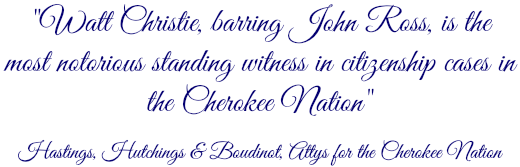
In the protest, the Cherokee Nation summarized the case, explaining Cumiford knew nothing of the family he claimed and that he relied solely on the testimony of Watt Christie, a well known standing witness, who had later recanted his testimony in the Cumiford citizenship case and confessed he only testified because Cumiford said he'd give him, Christie, a horse.

Because the Dawes Commission previously ruled the Cherokee Nation had not proved bribery took place, the Nation's legal staff went into great detail of the bribery and perjury in their protest to the Department of the Interior. 

They explained that the clause "Omit all such as may have been placed thereon by fraud or without authority of lawful right thereto" was added to the Curtis Act, "in order that jurisdiction might be confered upon the Commission to correct frauds which had heretofore been practiced upon the Cherokee Nation ... "

They emphasized the fact Cumiford had virtually disappeared and no one could find him. 
"The records will show that when Comiford took the stand to make the first application in his own behalf on November 9, 1900, he was then charged with having given Watt Christie a horse to testify in his behalf. Since that time conscious of his own guilt, conscious that he had committed bribery, conscious that he was guilty of subordination of perjury, this same Comiford fled from the Cherokee Nation and could not be found as shown by the testimony of J.C. Starr taken before the commission November 11, 1902."
The Cherokee Nation continued by proclaiming that while it was usually difficult to prove perjury, in this instance, Watt Christie, the witness, admitted to it.
"People do not usually go over the country and herald the fact that they are bribe-givers, or perjurers, but in this case the witness comes before the Commission and confesses his own guilt and at the same time Comiford conscious of it flees the country."
They explained why the Cumiford case slipped through, 
"... this is the only case where this Cherokee Commission, so far as we can find, ever admitted an applicant on the unsupported testimony of Watt Christie, [because] the putrid stench which attached to his reputation for veracity in citizen-ship cases soon came to the judicial nostrils of this Commission ... "
In conclusion, the Cherokee Nation stated, 
"If the Government of the United States is powerless because of any technicality to correct this fraud and injustice when the proof is so plain and convincing, then we say that it would be fruitless for the Cherokee Nation to request that any applicant be rejected on the ground of fraud being practiced."
Despite this grand effort by the Cherokee Nation lawyers to protect our nation from having its lands stolen by frauds pretending to be Cherokee, the Department of the Interior ordered the enrollment of Cumiford, saying their interpretation of the fraud clause in the Curtis Act did not apply to the circumstances in the Cumiford case. 

Though the Cherokee Nation lost in their attempt to keep a fraud out of our nation and off our Final Roll, it made a powerful promise in its final protest, should the US decide to rule against them. That promise grew from the pride Cherokees felt for their nation then and from the presumed pride we would all carry with us, even if we were born years after that final roll. Our forefathers knew the ever patriotic and loyal Cherokees would never allow for such fraud to be covered up or forgotten. 
 "If this Comiford family is permitted to reap the rewards of their own criminal corruption, ... the Government of the United States will rightfully be condemned by every ... [Cherokee] ... as long as there is left one to patriotically lisp: "I am Cherokee."

While that is the end of this standing witness case, it is not the end of this series. There is much more to be said, so join me next time when I discuss why this still matters.

Those are my thoughts for today.
Thanks for reading.


copyright 2014, Polly's Granddaughter - TCB

Tuesday, February 4, 2014

All Witnesses Were Not Created Equally - Standing Witnesses-Part 7


Those who applied for citizenship in the Cherokee Nation had to prove their relationship to an ancestor on one of the four rolls mentioned above. It wasn't an option, but instead a requirement. 


Cumiford originally filled out his citizenship claim using the name of his actual mother, Mary Sitton.


The problem was, Mary Sitton's name wasn't on any of the Cherokee rolls. Without a name on the roll, Cumiford's citizenship claim would have been denied.

At some point in time, after filling out his claim forms and prior to his hearing before the citizenship court, Cumiford began to claim through Rachel Fisher instead of his mother, Mary Sitton. Notice how Mary's name is crossed through and Rachel's is written instead.


It's unclear if Cumiford decided to claim through Rachel Fisher before or after talking to Watt Christie, but it's clear Cumiford never would have been admitted if not for Christie's testimony.

As shown in his testimony, Cumiford knew very little about the Fisher family. 


Compare that to all the information Christie shared about the Fisher family in two different testimonies.


Anyone could look at the rolls and find a name, but it took more than that to gain citizenship. A claimant needed others to testify they were actually Cherokee but Cumiford couldn't find honest people to testify. He was making a false claim. This is why Watt Christie became important to him. Christie got on the stand and under sworn oath, lied. 

The plan appears to have been well orchestrated. 

Both men said:
  • Rachel Fisher was Cumiford's mother.
  • Cumiford was born in the Cherokee Nation.
  • Cumiford was taken out of the Cherokee Nation, after the Civil War, when he was about 7 years old.
If two people tell the same story and it proves true, no harm, no foul; but if two people tell the same story and it proves false, then there had to be some planning involved. It is not a stretch to believe Watt Christie and Pleasant Cumiford conspired to defraud the Cherokee Nation. 

Christie's role didn't stop there. He also made a point to say Rachel Fisher's name should appear on the Rolls of 1852 and he later gave the name of Rachel's grandfather in Cherokee so it could be found on the Roll of 1835.

The name Fisher is not found on the Roll of 1835. It appears the citizenship court wanted to find the family on more than one roll so they recalled Christie to the stand for more information (second testimony).  Christie explained the family lived together (so only one head of household would be on the Roll of 1835.) He offered the name Hatchet and a Cherokee name, Dee kul loos ki. There is no Hatchet on the Roll of 1835. The court put an interpreter on the stand who explained the Cherokee name would have been recorded as Chopper. There was a Chopper, living on the Ellijay, near Turnip Town.


Cumiford might have been able to pull a name from the Drennen Roll on his own, but he never could have linked that name to the name Chopper on the Roll of 1835. He might have found other witnesses, but those witnesses never could have linked Rachel Fisher to her family listed on the Roll of 1835 either. Only a Cherokee with intimate knowledge of the family and who was willing to lie could have helped Cumiford get his claim approved. This is the reason the standing witness testimonies were harmful. While non-Cherokee witnesses could lie, they couldn't provide details that would get the citizenship court to believe those lies. A Cherokee could. Watt Christie proved that. 


Stay tuned for the next installments in this series for more about the Fisher family; why the standing witness testimonies are harmful; and why we as Cherokees should care.

Those are my thoughts for today.
Thanks for reading.


copyright 2014, Polly's Granddaughter - TCB

Sunday, January 26, 2014

Searching for Mrs. Fisher - Standing Witnesses-Part 6

As discussed earlier in this series on Standing Witnesses, Pleasant Cumiford claimed descent through a Cherokee woman named Rachel Fisher. Watt Christie, Cherokee, gave testimony regarding Rachel and her father, Fisher, making it possible for Cumiford to gain citizenship into the Cherokee Nation. The problem with it all is that Cumiford paid Christie to give false testimony and Cumiford did not descend through any Cherokee, let alone, Rachel Fisher.

It is important to show the ancestry of the Cherokee, Rachel Fisher, so it is clear the records of the Cherokee Nation can always be used to expose a fraudulent or fabricated ancestry like that of Pleasant Cumiford.

Watt Christie never mentioned the name of the mother of Rachel.  He mentioned Rachel and Fisher, her father. He said Rachel should be found on the roll of 1852 and Fisher should be found on the roll of 1835. But what of Rachel's mother? Christie said Rachel's parents lived together near Turnip Town on the Ellijay and that they went to Indian Territory with the Emigration, but he never gave the mother's name. So who was Rachel's mother?

According to the Eastern Cherokee Applications of Fisher's grandchildren, his wife was Polly Fisher, no maiden name given.


While I don't think anyone has ever found definitive proof that identifies Polly Fisher's parents, there is a lot of circumstantial evidence that suggests she was the daughter of Lacy and/or Betsy Christie and at least a half sister to Watt Christie.

In her Eastern Cherokee application, Watt Christie's daughter, Quaitsy (Betsy) Wolf, listed a Polly Fisher as an aunt on her father's side.


In her Eastern Cherokee application, Watt Christie's niece, Polly Ross, daughter of Arley Christie Grease, listed Polly Wa-gi-gu as a 1/2 aunt. Wa-gi-gu connects this aunt to her mother's side.


As you can see, both women listed Lacy Christie (War-kee-coo and Wa-gi-gu) as their grandfather and "Bittie"/a white woman as their grandmother. This matches what Mary (Christie) Manus, daughter of Watt Christie, said about her grandparents in her Eastern Cherokee application. 

Quaitsy Wolf and Mary Manus were siblings. Polly Ross was their first cousin. Quaitsy and Polly both reported a child of their grandparents, Lacy and/or Betsy Christie, named Polly. This means Quaitsy identified Polly Fisher as a sibling to her father, Watt Christie, and Polly Ross identified Polly Wa-gi-gu as a 1/2 sister to her mother, Arley Christie Grease/Greece. Watt and Arley were siblings and the children of Lacy and Betsy Christie. This information, in a family tree form, would look like the diagram below.


In order to avoid making the mistake of same name/different person, it is important to do an exhaustive search for information, extract the facts and then evaluate those facts to see if a conclusion can be formed as to whether Polly Fisher, sister to Watt and daughter to Lacy and/or Betsy Christie is the same Polly Fisher who was the wife of Fisher and mother of Rachel.

Watt Christie testified that Rachel's parents lived near Turnip Town on the Ellijay in the Old Cherokee Nation. This is true, per the 1835 Valuations and the 1838 Claims before Emigration, made in the name of Rachel's father as Hatchet. Lacy Christie was also living in the same area. This area was mountainous and travel was difficult (Hill), therefore, the Cherokees who lived in this region were fairly secluded from other Cherokee communities. There were only 38 families living on the Ellijay in 1835. Considering the topography of this region, and the fact not all who lived in the area would be single and marrying age, there would likely only be a small group of women available for Fisher to marry. Based on the approximate birth year of their son,Watt, it is possible Lacy and/or Betsy Christie's daughter, Polly Wa-gi-gu, was the right age to have been the wife of Fisher.

In Cherokee records from 1835 through 1851, the Fisher family is always found living near Lacy Christie and other members of his family. Fisher and Lacy Christie were even in the same detachment on the Trail of Tears. While this doesn't prove there is a familial connection between Fisher and Lacy, it suggests the possibility of one. Until the upheaval caused by the Civil War, it was quite common to find large, extended members of a Cherokee family living in close proximity to one another.
 

While there is no record of Fisher's wife's death, documentation indicates she probably died  before 1860, possibly as early as 1850. Polly's youngest child, born sometime between 1850-54, had no knowledge of her mother which suggests the child was quite young when Polly died. Additionally, prior to 1860, the Fisher surname was virtually unheard of in the Cherokee Nation. While there were Kingfishers, I've found no Fishers, specifically Fisher, on any rolls of the Cherokee Nation until the Drennen Roll of 1851-52. This roll had only one person named Fisher and he was the father of Rachel Fisher. Time and proximity make it highly likely the daughter of Lacy and/or Betsy Christie referred to as Polly Fisher by Quaitsy Wolf had a connection to Fisher. During the time frame in which Polly Wa-gi-gu appears to have lived, there were no other Fishers in the same area as the Christies.

Is all of this circumstantial evidence? Yes. Does that mean it leads us to make the wrong conclusion? No. The evidence and documentation allows a strong argument to be made that the Polly Fisher mentioned by Quaitsy Wolf and the Polly Wa-gi-gu mentioned by Polly Ross was the same Polly who was the wife of Fisher.

Consider these facts:
  • Watt Christie knew a lot about the Fisher family.
  • Watt Christie claimed kinship to the Fisher family.
  • The Fisher family lived near Lacy Christie in 1835 - Turnip Town/Ellijay.
  • The Fisher family lived near Lacy Christie in 1838 - Ellijay/Ellijay Town
  • The topography of the Ellijay area caused the Cherokees there to be secluded from other Cherokee communities, therefore limiting the pool of possible choices for a spouse for both Fisher and Polly Wa-gi-gu.
  • Fisher and Lacy Christie removed with the same detachment.
  • After the Trail of Tears, Fisher and Lacy Christie settled in the same area.
  • The Fisher family is found living among many from the Christie family on the Drennen Roll.
    • #563 - Lacy Christie
    • #564 - Arch Christie
    • #566 - Katy/Caty Christie
    • #568 - Fisher
    • #576 - Arley Christie
  • The Fisher surname was virtually nonexistent among the Cherokees before the Civil War.
  • Cherokee naming conventions suggest that if Polly Wa-gi-gu married Fisher, she would have taken his given name as her surname, thus becoming Polly Fisher, to represent "Polly, wife of Fisher". 
Is this enough information for us to conclude there was only one Polly Fisher who was both the daughter of Lacy and/or Betsy Christie AND the wife of Fisher? Not yet, but it is enough to make us consider it as a strong possibility. This is also enough information for us to conclude that Watt Christie did know the Fisher family and that he gave Pleasant Cumiford the details needed about that family to fool the citizenship court of the Cherokee Nation. 

While Pleasant Cumiford may have gone to his grave believing he pulled off his con against the Cherokee Nation, he couldn't foresee that, with the passage of time, more information would become available and allow his deception to be discovered. Slowly, through this series on standing witnesses, we have been peeling back the layers of lies to uncover the truth. We haven't just looked at Cumiford's family to show he fabricated a Cherokee ancestry. We've also looked at the family Cumiford claimed, the Cherokee Fishers. In stark contrast to Cumiford's non-Indian ancestry, we find the Fishers repeatedly in Cherokee records, which attests to the fact no fraudulent claim to Cherokee ancestry will be able to withstand the scrutiny of a thorough examination of documents and records. 

This isn't the end of Polly Fisher's story. Stay tuned for the next installment in this series where the fabricated ancestry, created by Pleasant Cumiford and Watt Christie, continues to collapse under the weight of the true story of Rachel Fisher and her family.


Those are my thoughts for today.
Thanks for reading.


copyright 2014, Polly's Granddaughter - TCB

Friday, January 17, 2014

The Devil is in the Details - Standing Witnesses-Part 5

There's more than meets the eye in the citizenship case of Pleasant Cumiford. While Watt Christie tried to downplay his role in citizenship cases by claiming he often didn't know what he testifying to, this can't be true in the Cumiford case.  Christie gave oral testimony in that case. He had to know what he was testifying to, under sworn oath, because it came out of his own mouth, in his own language.

In Christie's testimony, he admitted he and Cumiford talked for a while. Christie said that was when he recognized Cumiford as his kin, the son of Rachel Fisher. Is it possible this conversation is when the two men set their plan in place to get Cumiford a Cherokee citizenship?

At some time, the two men must have conspired to blend the history of two families in order to make Cumiford appear to be a Cherokee.While it is possible, it is not probable, that the surname Fisher was an impromptu choice by Christie. It would have been quite a coincidence considering Pleasant Cumiford's mother's mother was a Fisher; not a Cherokee Fisher, but a Fisher, nonetheless.

Pleasant's mother, Mary E. Sitton, was the daughter of Vincent Ridley Sitton and Amilly Fisher, who were married August 18, 1833 in Pettis County, Missouri.


Knowing this is enough for us to realize this Fisher family could not have been the one Christie gave many details about because he said Rachel Fisher's family lived near Turnip Town on Ellijay before the removal and that they went to Indian Territory with the emigrants. If true, that means they were in the Cherokee Nation East until late in the year 1838. Cumiford's maternal grandmother was in Missouri five years before the removal, as seen in the marriage record above.

Except for the surname of Cumiford's maternal grandmother, everything Christie shared was about a different family, an authentic Cherokee family. Christie elaborated in his original testimony by saying Rachel's father was named Fisher and her family lived in Goingsnake District after the removal. On the page below, taken from the Drennen Roll, see family #568. The head of the family is "Fisher". Listed later is a family member named Rachel. They were living in Goingsnake District, not far from Watt Christie's father, Lacy.


In 1838, Fisher was a witness in a claim his mother, Ailcy, made against the US government for losses. Ailcy lived in Turnip Town. Fisher lived near Turnip Town on Ellijay. This is verified again with Fisher's own claim in 1838 that said he lived on Ellijay. Remember, Christie said Cumiford's mother's family lived near Turnip Town on Ellijay.

Later, Fisher (aka Fishing Hatchet) filed a claim in 1842 and said he removed from the east with the Elijah Hicks detachment. Lacy Christie's (Watt's father) family also traveled with this detachment.


Notice the name of the witness on Fisher's claim - Wattee. Coincidence that Watt Christie's name in Cherokee is Wa-de? Maybe or maybe not. Since they were kin, it is quite possible Christie was a witness for Fisher.


The devil is in the details, folks. Watt Christie furnished all the information needed to bamboozle the Cherokee citizenship court and he did it by presenting facts about a real Cherokee woman and her family. He would have had intimate knowledge of the family he helped Cumiford steal because, not only did he live near the family, in both the old and new Cherokee Nations, but also because he was related to them.
  • Rachel did exist. 
  • Rachel's father was named Fisher.
  • Rachel's family did live in the Goingsnake District after the removal. 
  • Rachel's parents did live near Turnip Town in the old Cherokee Nation East.
  • Rachel's family left the Cherokee Nation East in the fall of 1838.
  • Rachel was related by blood to Watt Christie.*

But Rachel was not the mother of Pleasant Cumiford.

Rachel Fisher was the mother of many children, but Pleasant Cumiford wasn't one of them. It is unlikely Cumiford realized, that while he was living in the Cherokee Nation enjoying citizenship, Rachel was alive and well and living in the Cherokee Nation too. Unfortunately, she was unaware of the fraud being perpetuated against her and therefore could not have done anything to prevent it.

Stay tuned for the next installments in the Standing Witness series where I share more about Rachel Fisher, her family and the fact she almost missed out on her Eastern Cherokee payment because of the confusion about her family. 


Those are my thoughts for today.
Thanks for reading.


copyright 2014, Polly's Granddaughter - TCB

Monday, January 13, 2014

Pleasant Cumiford: In His Own Words - Standing Witnesses-Part 4


In 1887, a man named Pleasant Cumiford applied for citizenship in the Cherokee Nation. According to the testimony of standing witness, Watt Christie, Cumiford was born in Goingsnake District, Cherokee Nation, about 1857, to a Cherokee woman named Rachel Fisher. Christie testified that Cumiford's mother, a cousin to Christie, left the nation with her husband after the war and he never saw her again. Christie continued by adding that Cumiford's mother, Rachel Fisher, was about 3/4 Cherokee and she was small when she came with the Emigration. He said Rachel's parents lived near Turnip Town in the Old Nation and that her father's name was Fisher.

Pleasant Cumiford was admitted citizenship into the Cherokee Nation based on this testimony by Watt Christie.


But should Cumiford have received citizenship into the Cherokee Nation? Only an examination of his earlier life will reveal the answer to that question.

Pleasant Cumiford is found on the 1860 US Census, four years old, living with his father, Henry S. Cumiford (see Eastern Cherokee application) and a woman named Mary Cumiford, in Henry County, Missouri. His birthplace is recorded as MISSOURI. *Also note this is before the war. According to Watt Christie, Pleasant wasn't taken out of the Cherokee Nation by his mother until AFTER the war.


In 1870, Cumiford is found on the US census of that year, as 13 years old, again living with his father, Henry, and the woman named Mary, in Bates County, Missouri. His birth place is once again recorded as MISSOURI. His race is listed as WHITE.


I don't find Cumiford in another record until 1887 when he applied for and received citizenship into the Cherokee Nation, but the two censuses above bring into question the legitimacy of his claim that Rachel Fisher was his mother and that he was born in the Cherokee Nation. 

As stated earlier, Pleasant Cumiford acknowledged that his father's name was Henry. 

Henry Cumiford married a Louisa Thompson on January 20, 1848, in Missouri. Two sons, Benjamin and Wiley, were born to them before Louisa's death in 1853. Henry then married Mary E. Sitton, daughter of Vincent Ridley Sitton, in Pettis County, Missouri, on November 1, 1855.


Because of the gap between marriages, it is important to narrow down the birth year of Pleasant to evaluate whether he might have been born before or after the marriage to Mary Sitton. 

From 1860 through 1902, his birth year is consistently recorded as 1856 or 1857.


Not only does it appear that Pleasant was born AFTER Henry's marriage to Mary, the approximate birth year also strongly suggests Mary was his mother, as well as the mother of the children that were born after Pleasant. 

Odd as it is, knowing they were all born AFTER their father's marriage to Mary Sitton, Pleasant's siblings filed several applications for citizenship into the Cherokee Nation, claiming they, too, were the children of Rachel Fisher.

In their 1896 application, there were three affidavits that stated the four siblings; Pleasant, Vincent, Robert and Wilbi, were full siblings. One of those sworn testimonies included, in his own words, from Pleasant Cumiford himself:

"I am 39 years of age. Vince and Robert Cumiford and Wilbi J. Masingill (nee Cumiford) is my full brothers and sister. And our mother was one and the same woman."


Henry S. Cumiford married Mary E. Sitton before these children were born and he was living with her after these children were born, so it is logical for us to think she was the mother of his children. Pleasant Cumiford swore under oath that he and his three younger siblings were full siblings and they all had the same mother. 

So who was their mother? 

According to Vincent Ridley Cumiford's death certificate, his mother, and therefore the mother of his three full siblings, including Pleasant Cumiford, was MARY SITTON, a white woman born in Missouri. *Note that Vincent was named after Mary's father. 


Pleasant Cumiford was NOT the son of Rachel Fisher, nor was he Cherokee. But he gained citizenship into the Cherokee Nation with the help of standing witness, Watt Christie. Stay tuned for the next installment in the Standing Witness series, The Devil is in the Details, where I continue to debunk the lies told by both Pleasant Cumiford and Watt Christie.

Those are my thoughts for today.
Thanks for reading.


copyright 2014, Polly's Granddaughter - TCB

Thursday, January 9, 2014

Watt Christie: In His Own Words - Standing Witnesses-Part 3


In 1887, Pleasant Cumiford applied for citizenship into the Cherokee Nation. He needed a witness and sought out an old Cherokee, Watt Christie. Christie gave oral testimony that he knew the man's mother, that she was a relative of his, and that she had left the Cherokee Nation after the war and never returned. 

(note - the date is the file date, not testimony date)


Cumiford was admitted. But, he wasn't Cherokee. This was one of the early cases in which Watt Christie acted as a standing witness. It slipped through, only to come up again, 9 years later.

***
In 1896, Cumiford's brother, who had already been denied citizenship, applied again. True to form, Watt Christie acted as a standing witness, but this time, Sam Manus, Christie's son-in-law, also testified. The truth about the 1887 Pleasant Cumiford citizenship case finally came to light. Manus, under oath, repeated what Christie had told him:  Christie didn't know Cumiford; he didn't know Cumiford's people; and he didn't know if Cumiford was a Cherokee or not.


Manus' testimony prevented Cumiford's brother from gaining citizenship into the Cherokee Nation, but it did nothing to change the citizenship of Cumiford himself. But it wouldn't be long before the 1887 case would come up yet again. 

***

In 1900, Cumiford applied for the Dawes Roll. During questioning, after hearing Cumiford was admitted to the Cherokee Nation solely on the testimony of Watt Christie, the Cherokee Nation attorneys protested and the case was put on hold. About two weeks later, Christie testified before the commissioner. Apparently Cumiford didn't pay him for that testimony, because Christie actually told the truth. 

Christie didn't know Cumiford, or Cumiford's mother, or Cumiford's father. He didn't know any of Cumiford's people.


Though too little, too late, in his own words, Watt Christie admitted he lied and that he received compensation to do it. 

Unfortunately the confession did not fully disclose Christie's deceit in this case, nor did it undo the damage the preceding lies had caused.  Join me next time when, after 112 years, this case comes up yet again. I'll discuss Pleasant Cumiford, the ancestor-stealing conman, who capitalized on the availability of standing witnesses to bribe his way into Cherokee citizenship.

Those are my thoughts for today.
Thanks for reading.


copyright 2014, Polly's Granddaughter - TCB