Showing posts with label Nelson Guess. Show all posts

Saturday, February 20, 2016

The Children of Nelson Guess - Part 2


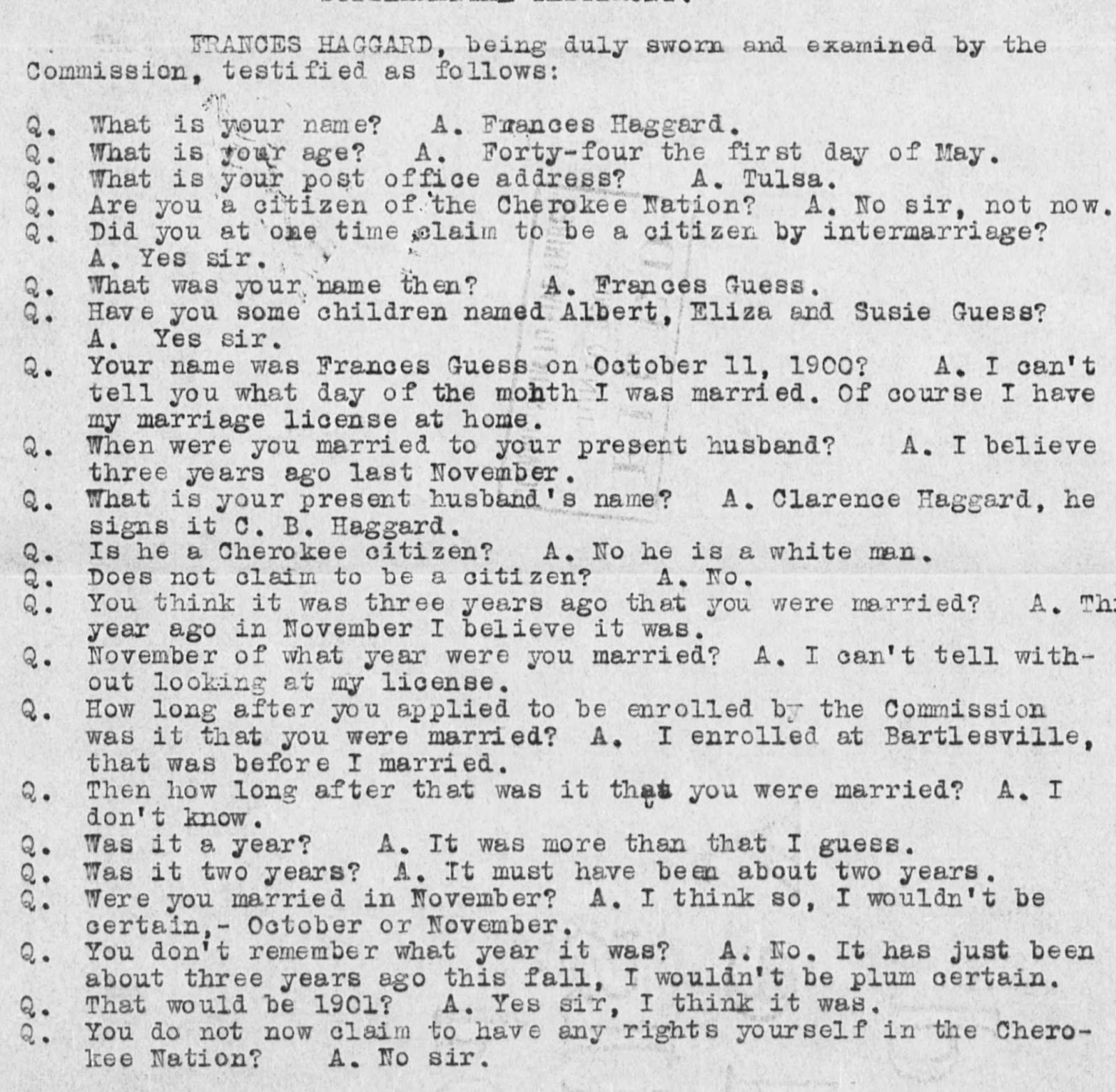
Sometimes it's best to let the documents tell the story. In The Children of Nelson Guess - Part 2, that's what I've decided to do. A lot of words aren't needed to explain how tragic and sad this was.

June 20, 1908, Albert Guess, the teenage son of Nelson Guess, died in Tulsa, Oklahoma.


July 9, 1908, Clarence Haggard, white stepfather and guardian of Albert, was appointed as administrator of Albert's estate.


August 6, 1908, Despite the fact she was purportedly the child of Nelson Guess and received an allotment because of it, Lena was listed as "Lena Haggard" and as the 1/2 sister of Albert in the estate papers listing his heirs. We know Albert and Lena had the same mother, so obviously Lena was not the child of Nelson Guess. (See Part 1 for more.)


June 22, 1909, Clarence was cited and summonsed to court for failure to follow through with the legal requirements in his role as guardian of the children of Nelson Guess.


March 2, 1910, another citation was issued commanding Clarence to appear in court on March 30, 1910, to face a complaint from the surety company that he had absconded with the estates of the children of Nelson Guess (as guardian) and had not complied with the requirements of guardianship for more than a year.


April 16, 1910, on the 1910 US Census, Lena was listed as Lena Haggard and Susie was listed as Susie Guess. Clarence was not listed in the household.


May 12, 1910, in Susie's estate, Lena was listed as Lena Haggard and as the 1/2 sister of Susie. That same day, Clarence signed for Lena in Susie's estate papers and signed her name as Lena Haggard.


July 9, 1910, Frances reported that Clarence was squandering the estates of her children (as guardian.) Clarence was therefore ordered to appear in court to answer to Frances' allegations against him. The court date was set for July 25, 1910.


October 10, 1910, the the court ordered that Clarence appear in court to answer the accusation that he absconded with Albert's estate (as administrator.) Later, the sheriff reported he could not find Clarence in his jurisdiction to serve him with the order to appear.


March 23, 1911, Clarence was again ordered to appear in court to answer to charges of absconding with the estates of the children of Nelson Guess (Albert, Eliza, and Susie.)


April 11, 1911, Clarence was removed as guardian of the estates the children of Nelson Guess; Albert, Eliza, and Susie; as well as removed as guardian for the estate of his own daughter, Lena Haggard, alias Guess.


After all those documents, it should be clear that Clarence Haggard took advantage of his role as guardian to Cherokee children and basically stole their estates. Though I didn't include the documents in this post, he did request and receive approval to sell at least part of the allotments received by Albert and Susie. After he sold the land, he then absconded with the money received from the sale.

In Part 3 of The Children of Nelson Guess, I'll summarize the facts surrounding the tragic story of theft perpetuated by Clarance and Frances Haggard against these three Cherokee children and the Cherokee Nation as a whole.

Those are my thoughts for today.
Thanks for reading.


*All probate documents above can be found on Ancestry.com: Oklahoma Wills and Probate Records of Albert Guess, Susie Guess and Lena Guess 

Copyright 2016, Polly's Granddaughter - TCB

Friday, December 18, 2015

The Children of Nelson Guess - Part 1

Like Sequoyah Guess (b. 1890), Albert Guess was only a little boy when his father died and he was dependent on others to make sure he and his siblings were enrolled by the Dawes Commission. Sadly, Albert did not have adult Cherokees looking out for his best interest (or the interest of his sisters) so things didn't go as well for him as they did for Sequoyah Guess.

After Nelson Guess, Albert's father, died in 1896, his white wife, Frances, remarried. Available documentation from 1900 to 1913 indicates Frances and her new husband, a white man named Clarence Haggard, were more interested in what they could get from the Cherokee Nation and Nelson's Cherokee children than they were in taking care of those children and looking out for their best interests.

June 1900, the family was found on the U.S. Census. Clarence was listed as head of household with Frances as his wife; Dorcas Damon (child of Frances before her marriage to Nelson Guess) as his step daughter; Albert, Eliza, and Susie Guess as his step children; and Lena Haggard as his daughter. Lena was listed as born April 1899 and one year old.


Later that year, in October 1900, Frances applied to the Dawes Commission for herself as an intermarried white and for Nelson's three children, Albert, Eliza, and Susie, as Cherokees by blood. She said Nelson Guess died three years prior (1897) and that she had not remarried since his death.


Technically, she was honest because she and Clarence didn't marry legally until September 1901.  

To make that clear, Frances Guess, widow of Nelson Guess, legally remarried in 1901 though she'd already been living with the man prior to the marriage based on information from the 1900 U.S. Census.


In September 1902, WC Rogers, a store owner, wrote a letter to the Dawes Commission reporting Frances as a fraud, saying she had a new man, Clarence "Haggar", and had two children by him. He said she only had three children who were Cherokees, Albert, Eliza, and Susie.


October 1902, Frances gave additional testimony to the Dawes Commission. She said Nelson had been dead about 6 years (1896) and that she was still a widow (unmarried) on September 1, 1902. That same day, Mary "Katie" Flemming Pruett, a daughter Frances had from a marriage previous to her marriage to Nelson Guess, gave testimony that her mother had not remarried. Clearly, Frances and Katie lied.


In March 1903, Frances was again questioned by the Dawes Commission and said she did not know Clarence "Hagar" and that she was not married. She also said Susie was her youngest child and that she'd had no children since Nelson's death. Frances lied again.


May 5, 1904, JC Starr testified before the Dawes Commission and reported that Frances tried to bribe him, first with $100, then $200, to not report that she was married. She told him that she gave false testimony to the Dawes Commission and that if asked again, she'd repeat what she said even though she knew it was not true.


Finally June 1, 1904, Frances testified before the Dawes Commission as Frances Haggard. She admitted she had remarried and that she could no longer claim rights as an Intermarried White.


Three days later, on June 4, 1904, Clarence Haggard sought guardianship of Nelson's three children. He said each was entitled to $975 from the Cherokee Nation (with inflation, this calculates to approximately $25,000 each as of 2014) and needed someone to oversee their estates for them. Clarence was granted guardianship.


Two years later, on May 8, 1906, Frances applied to the Dawes Commission for her daughter, Lena. She testified Lena was the child of Nelson Guess and born after his death. When questioned about why she had never tried to enroll Lena previously when she had enrolled the other children, she said she just never did. She said Lena was her youngest child (though she actually had a son younger named Icem/Isom.)


Later that year, on December 26, 1906, Frances filed an Eastern Cherokee application for Albert, Eliza, and Susie. She did not mention Lena. Four times she said Nelson Guess died in 1896. She said she married Clarence Haggard in 1898.


While it's clear, based on the documentation, that Lena was the biological child of Clarence Haggard, and it is clear that Frances lied about Lena's paternity, on February 19, 1907, Lena was approved for enrollment on Dawes as the child of Nelson Guess. The Cherokee Nation lawyers did not challenge the enrollment despite the conflicting testimonies and lies Frances told in her previous attempt to get herself enrolled.


Unfortunately, that is not the end of the story. Stay tuned for the part two of  The Children of Nelson Guess where more of this sad tale of lies and deceit will be continued.

Those are my thoughts for today.
Thanks for reading.


copyright 2015, Polly's Granddaughter - TCB

Tuesday, October 20, 2015

The Orphan Tree: The Lineage of a Cherokee Family Pt 4

When a parent dies, it is not uncommon for a child to lose contact with that side of their family. When multiple generations repeatedly lose the parent from that same lineage, a disconnect from that side of the family is not surprising. Big Dollar's descendant tree could easily be described as an orphan tree. While we may never know why his descendants were forgotten by nearly everyone outside his family, it's possible the high percentage of orphans descending from him could be the reason.

Sequoyah Guess (b. 1890) was an orphan. We know that from a previous post but he was far from being the only descendant of Big Dollar who was either left an orphan or who lost their Guess parent early in their lives.

Big Dollar died when his four children were eleven years old or younger. While those children were raised by their mother, Tianna, at least one, Nancy, became an orphan before reaching adulthood. It's possible the others were completely orphaned as well. Records aren't available to conclusively determine when their mother died. It is also not known how much information about their ancestry from their father's side had been shared with them.

Nancy, daughter of Big Dollar, lived long enough to raise her son, Peter Dennis, to the age of majority. Her brothers were not so fortunate. Robert died, leaving his two daughters, Nancy Nolen and Betsy Ketcher, orphans at very young ages. William died leaving at least two, possibly all of his children, Dave Guess, Nancy Sticks, and Alice Beamer, without their father before they were adults. Moses raised his son, Nelson, to adulthood, but left two other children, George Guess and Martha/Sa ke Boney, as orphans.

Over 75% of Big Dollar's children and grandchildren lost their parental connection with their Guess family before becoming adults. Sadly, the trend continued into the generation of great grandchildren. Dave Guess, son of William, left four orphans when he died, and Nelson Guess, son of Moses, left three orphans (plus one "too late" baby - to be discussed later), at the time of his death.

The image below identifies the descendants of Big Dollar, who as minors, lost their Guess parent. 
Click to enlarge
The tragedy is not just that they were orphans, but also that they were forgotten, not only by their extended Guess family, but also by Emmet Starr and some 'researchers' of today. As genealogists, it is our responsibility to ensure we have done a reasonably exhaustive search of records before we declare anything as fact. This is especially important before we proclaim that a person had no descendants. Each person in the diagram above has a story waiting to be told. It is our job to tell that story, not erase them from history by alleging they did not exist.

While time does not allow for extensive writing about all of Big Dollar's descendants, records of their lives indicate that most were taken in by extended family and raised by Cherokees who looked out for them and their best interest. Sadly, that was not the case for all.

There is one heartbreaking story that must be told. Not only does it serve as an example of how easily an orphaned Cherokee child could be exploited by unscrupulous people, it also exposes several instances of fraud either attempted or perpetuated against the Cherokee Nation by a deceitful, non-Indian couple.

Stay tuned for more of The Lineage of a Cherokee Family where the sad story of one sibling group, the orphans of Nelson Guess, will be told.

Those are my thoughts for today.
Thanks for reading.


copyright 2015, Polly's Granddaughter - TCB